- What is Zepto, and How Does Zepto Work?
- How Zepto Works for Customers
- What Are Dark Stores?
- How Zepto Actually Makes Ultra-Fast Delivery Work (Behind the Scenes)
- The Technology Behind Zepto’s Quick Delivery Model
- How These Blocks Fit Together (User Roles)
- The Unified Technology Framework Powering 15-20 Minute Delivery Apps
- Does Zepto Follow the Industry’s Best Practices?
- Zepto vs Blinkit vs Instamart vs BigBasket
- Zepto’s Business Model
- Conclusion
- Frequently Asked Questions (FAQs)
Table of Contents

How Zepto Delivery Works: The Logic Behind the Speed


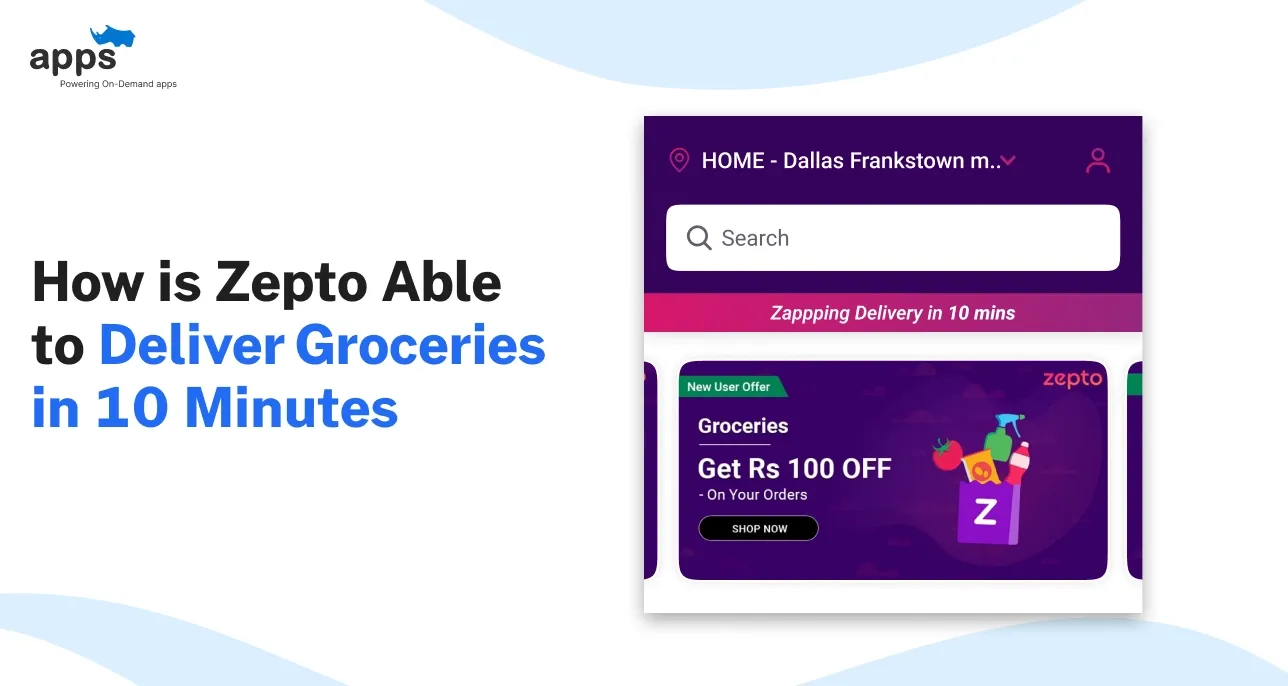
Speed has quietly redefined how India shops for essentials.
Zepto delivery has emerged as a benchmark in instant convenience, with many customers associating the brand with the idea that Zepto delivers groceries within minutes across major cities.
What once sounded ambitious in traffic-heavy urban areas is now part of everyday life for Zepto app users. As an online grocery app, Zepto grocery delivery focuses on ultra-fast fulfilment, optimized dark stores, and precise logistics.
But how does Zepto work so efficiently? What determines the actual Zepto delivery time, and how closely does it align with the widely discussed “instant delivery” promise?
This blog breaks down the strategy, operations, and technology powering Zepto's doorstep delivery and what it means for the future of grocery delivery service in India.
What is Zepto, and How Does Zepto Work?
Zepto is a fast-growing grocery delivery service known for its ultra-quick fulfilment model. Founded in 2021 by Aadit Palicha and Kaivalya Vohra, Zepto set out with a simple goal to make online grocery shopping faster, more convenient, and accessible across urban India.
Through the Zepto app, users can order essentials like fruits, vegetables, snacks, and other daily items from nearby grocery stores for delivery. Instead of using large warehouses, Zepto relies on smaller dark stores located near customers.
This setup helps ensure products are always available and delivered fresh. That’s what makes Zepto delivery not just fast but reliable.
How Zepto Works for Customers
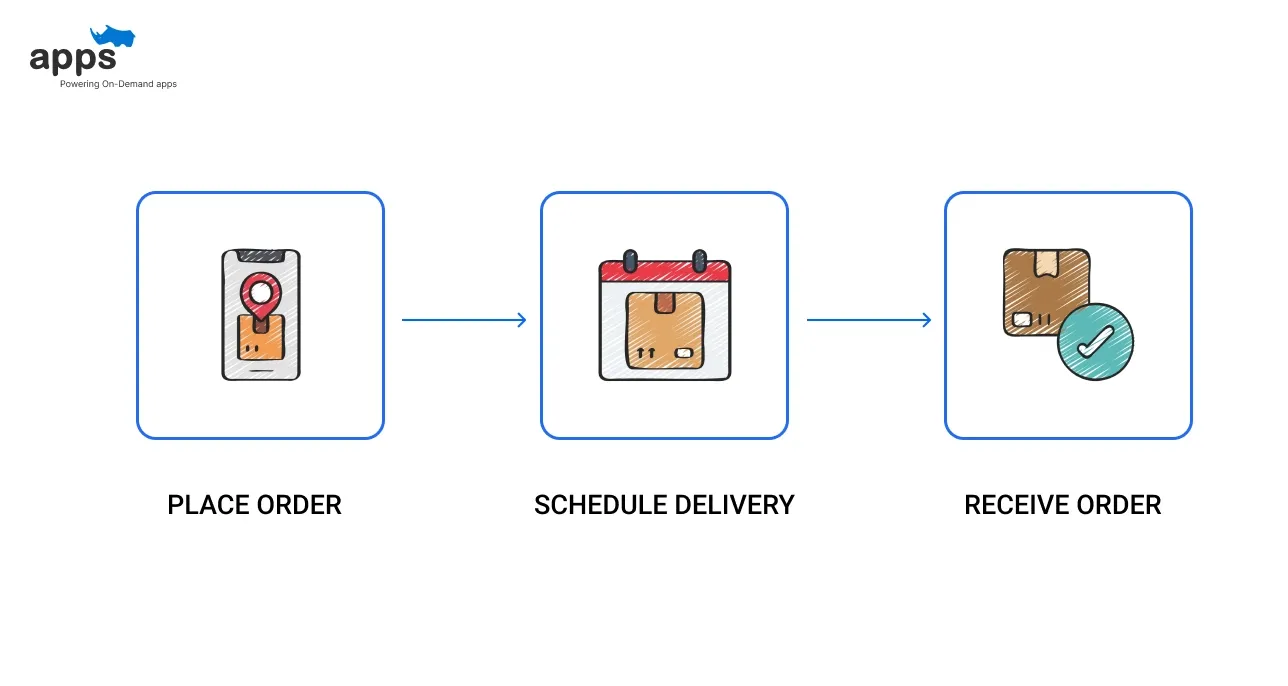
Ever wondered how Zepto works so seamlessly for millions of customers?
The process is designed to make grocery shopping instant and effortless, from browsing in the Zepto app to receiving groceries at your doorstep in minutes.
Here’s a simple breakdown of how Zepto works for customers and how its Zepto delivery system enables ultra-fast grocery delivery across urban areas.
1. Finding and Setting Location
When a customer opens the Zepto app, it automatically detects their location or allows them to set it manually.
This helps Zepto connect them to the nearest dark store, usually just 1.5 to 2.5 km away, making Zepto's delivery work efficiently from the start.
2. Browsing and Choosing Products
Customers can explore a wide range of Zepto grocery items, including fruits and vegetables, snacks, beverages, and household essentials.
The app shows real-time availability, ensuring only stocked products are displayed.
3. Placing the Order
After selecting items, customers head to checkout, choose their preferred payment method, and confirm the order.
That’s when the system kicks in, and the real process of how Zepto delivers groceries in minutes starts.
4. Instant Order Allocation
Once the order is placed, Zepto’s technology instantly assigns it to the nearest dark store.
This is where Zepto’s approach becomes impressive: these stores are stocked based on local buying patterns, so the ordered products are always nearby and ready to be picked up.
5. Picking and Packing
The dark store team receives an automated picking list immediately.
Items are scanned, packed, and sealed in under 60–90 seconds. The process is fully digitized, showing how Zepto delivers groceries in 15-20 minutes and remains consistent every time.
6. Rider Assignment and Delivery
Once packed, AI automatically assigns a rider who’s already in the area.
The route is optimized using live traffic, weather, and delivery density data. This smart system explains how Zepto delivers so fast and why Zepto's delivery time averages under 30 minutes.
7. Real-Time Tracking and Arrival
Customers can track every step in real time through the Zepto app from order confirmation to arrival.
Most deliveries arrive faster than expected, making Zepto's ultra-fast delivery a reality for thousands of users daily.
8. Post-Delivery Experience
Once delivered, customers can rate the order, tip the rider, and reorder frequently purchased products with a single tap.
It’s a smooth, connected experience that demonstrates Zepto's precision, combining customer satisfaction with operational efficiency.
9. Delivery Confirmation
The rider marks the order as delivered in the Zepto app, automatically notifying both the customer and the system.
10. Customer Feedback & Ratings
The app prompts the customer to rate their delivery experience, product quality, and rider behavior.
This feedback helps Zepto monitor service quality and improve how Zepto's delivery works in real time.
11. Support & Issue Resolution
If there’s a problem, such as a missing item or a quality concern, customers can raise a ticket through in-app support.
Zepto’s customer care team responds quickly, ensuring Zepto's operations remain customer-first.
12. Reorder Suggestions
Based on previous orders, Zepto recommends frequently purchased items or offers discounts to encourage repeat use.
This builds loyalty and increases engagement within the Zepto app.
In the next section, let’s take a quick look at what exactly it is and how it works.
What Are Dark Stores?
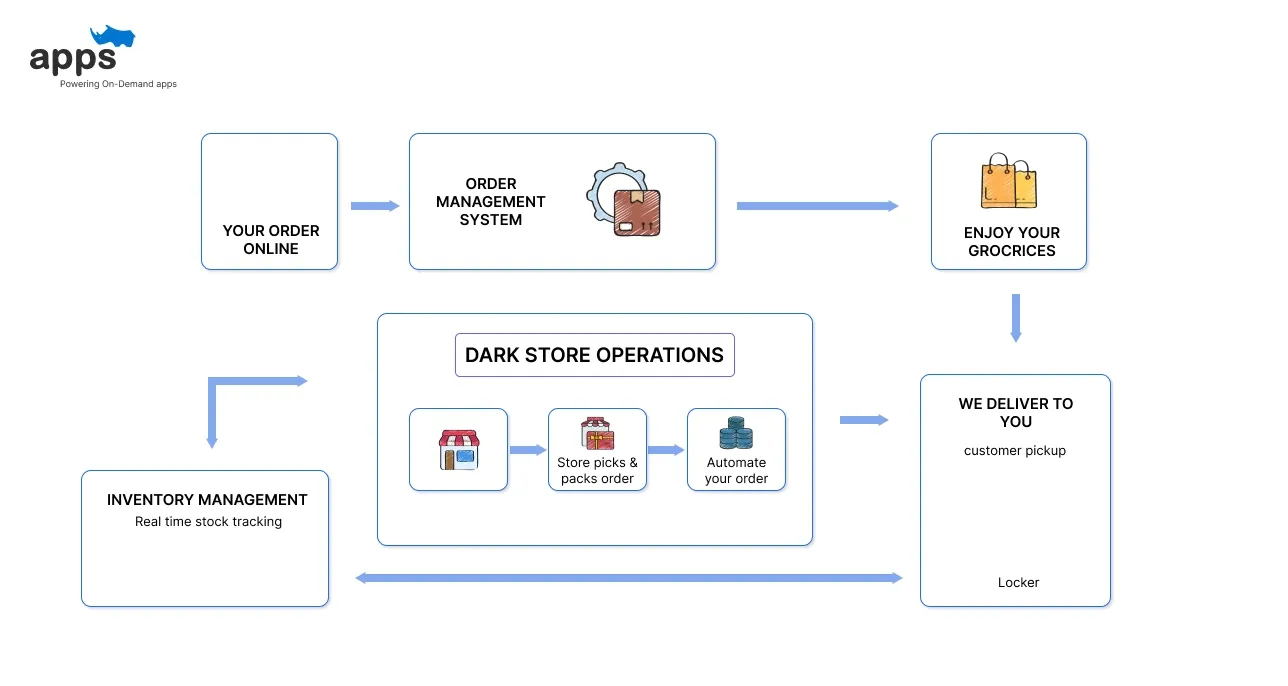
Dark stores are small, tech-enabled warehouses made only for online grocery orders, not walk-in shoppers.
Each store stocks around 2,000–3,000 popular items chosen through data insights, helping staff pick and pack in under a minute.
For Zepto grocery, these dark stores are placed strategically within 1.5–2.5 km of customers to ensure faster dispatch and fresher deliveries. This hyper-local, data-driven setup is the secret behind how Zepto delivers groceries in minutes with precision and consistency.
How It Works
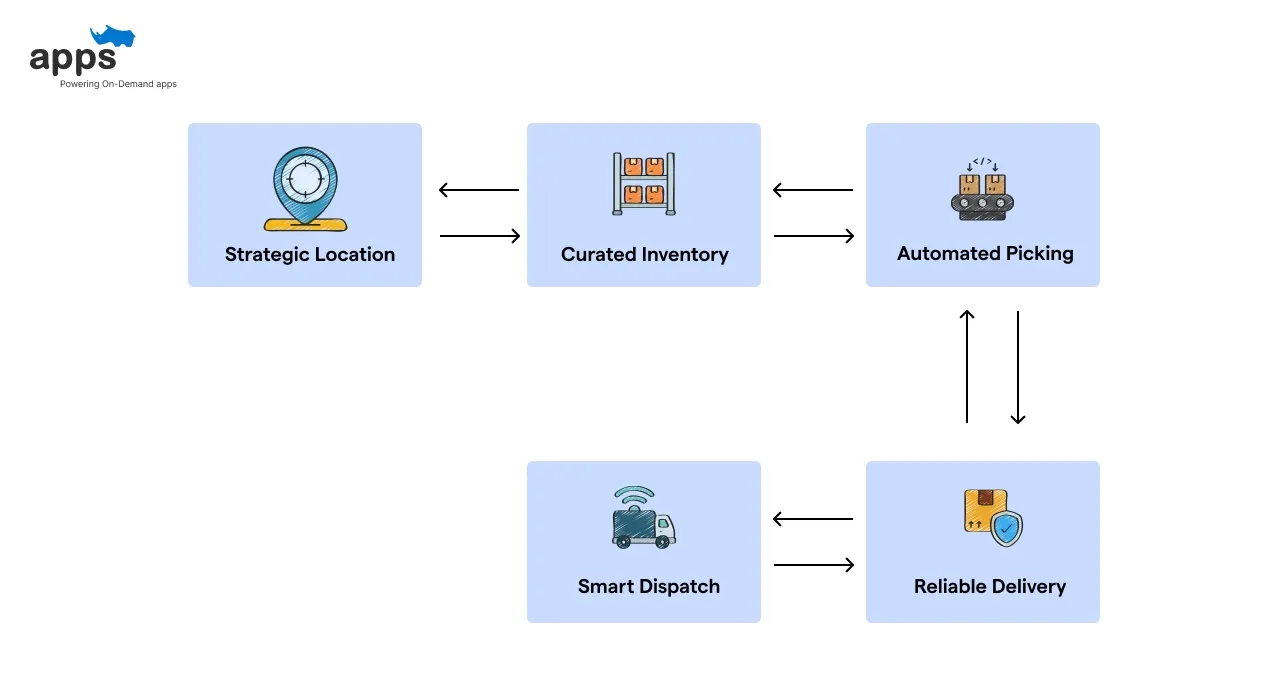
- Strategic Location: Each store is set up close to high-demand residential areas for quick access.
- Curated Inventory: Only fast-moving essentials are stocked based on local shopping behavior.
- Automated Picking: Staff follow digital picking routes using barcode scanners for faster processing.
- Smart Dispatch: Real-time systems assign riders based on proximity and live traffic data.
- Reliable Delivery: Short distances and automation make Zepto delivery quick, accurate, and fresh.
How Zepto Actually Makes Ultra-Fast Delivery Work (Behind the Scenes)
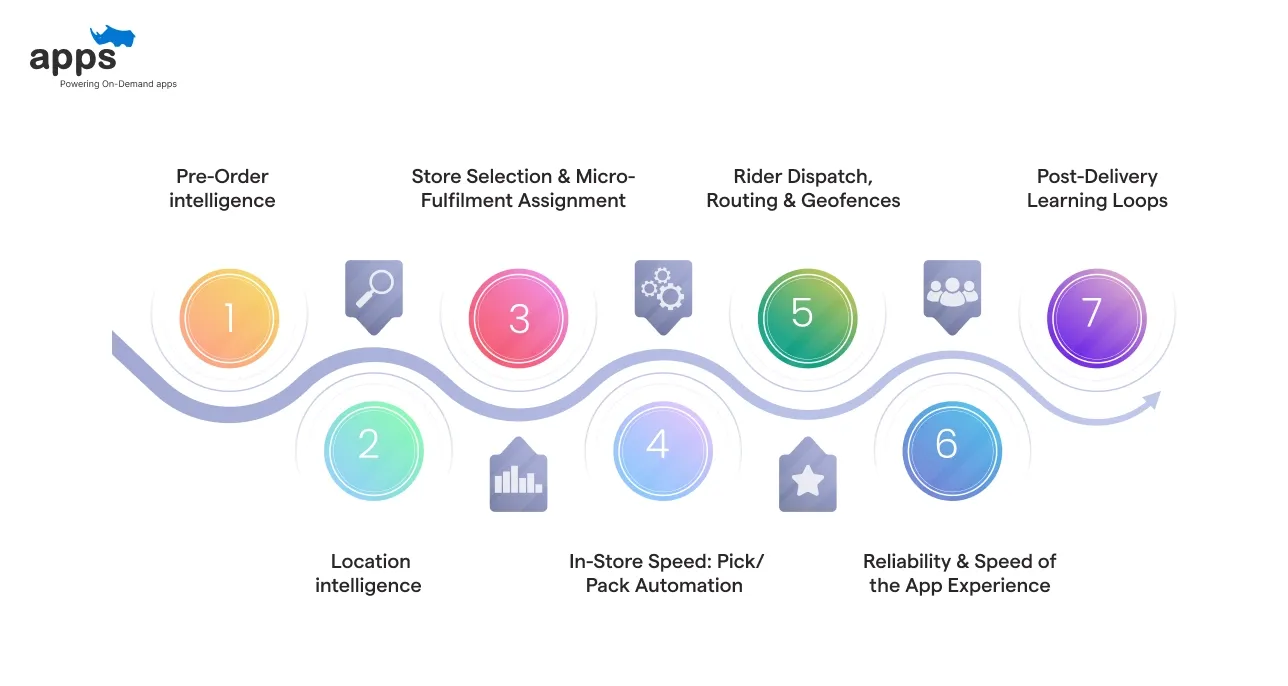
Zepto’s promise to deliver groceries within minutes isn’t just about a fast rider. It’s a stack of in-house mapping, geospatial databases, ML ranking, operational automation, and observability designed to shave seconds at every step.
Below is the end-to-end system from pre-order intelligence to post-delivery learning grounded in Zepto’s own engineering posts and top-tier business reports.
1. Pre-Order Intelligence: Search, Suggestions, and Availability
- Personalized Search Ranking: Zepto applies learning-to-rank to reorder results based on your context (signals like session behavior, popularity, price sensitivity). This reduces time to cart and increases the chance that in-stock, nearby items are chosen, key to how Zepto delivery works.
- First-party catalog + stock freshness: Ranking pipelines are tied to live availability feeds, so the app is less likely to recommend out-of-stock SKUs critical for ultra-short zepto delivery time windows.
2. Location Intelligence: Mapping for Ultra-Short Hops
- Zepto Maps (in-house): Zepto rebuilt its maps to address India-specific pain points, such as misplaced pins, unmarked gates, and society entrances, because “every meter counts” in Zepto's 10-minute grocery delivery. Better address resolution reduces rider detours and missed gates.
- Geospatial Engine (Tile38): Under the hood, Zepto has optimized a high-performance geospatial store to run fast “nearby/within” queries for store selection, rider assignment, and geofencing, improving ETA reliability for 15-20-minute delivery.
3. Store Selection & Micro-Fulfilment Assignment
- Nearest Viable Dark Store: The system matches the order to a micro-warehouse within a tight radius, balancing distance, stock freshness, picker load, and rider availability, core to how Zepto delivers in 15-20 minutes. Zepto’s map/geo improvements shrink last-meter errors that typically break ETAs.
4. In-Store Speed: Pick/Pack Automation
- Digitized Pick Paths: Pickers get optimized routes and digital pick lists; shelf maps and barcode validation cut seconds and reduce mispicks. Zepto delivers in about 15 minutes and stays repeatable at scale.
- Order Batching Under Constraints: Orders that share aisles/sections can be batched without breaking the quick and fast delivery SLA; ML/rules decide when to batch vs. single-pick to protect zepto delivery time.
5. Rider Dispatch, Routing & Geofences
- Dispatch with Live Traffic: Rider assignment uses live proximity and traffic signals from Zepto’s geo stack; address normalization and building-level landmarks from Zepto Maps reduce last-mile friction, which is vital to how Zepto delivers so fast.
- Geofencing Triggers: Tile38-style geofences fire events (leave store, near drop-off, delivered) so ops can intervene early if an ETA slips. The key to how Zepto delivers in 12-15 minutes.
6. Reliability & Speed of the App Experience
- Zero-Downtime Mobile Updates: Zepto automated multi-version CodePush so critical UI/logic fixes ship fast across app cohorts, keeping the experience responsive during peak windows.
- End-to-End Observability: A standardized telemetry layer (traces/metrics/logs) helps SREs and product teams spot regressions that could slow zepto delivery or search flows, one of the quiet levers behind “speed that sticks”.
7. Post-Delivery Learning Loops
- Continuous feedback into ML: Delivery outcomes (actual vs. predicted ETAs, hand-off issues, address corrections) feed Zepto’s ranking, mapping, and dispatch models. That’s how Zepto works to get faster in each neighborhood over time.
In short, how Zepto works isn’t magic; it’s precision engineering powered by AI, data, and automation. Every second saved is why Zepto delivers groceries in a few minutes truly works.
We have learned how Zepto’s rapid delivery works. But it is also essential to understand the technology and software behind it. Without wasting any more time, let’s begin with it.
The Technology Behind Zepto’s Quick Delivery Model
Behind every order lies a smart web of automation, data, algorithms, and multiple software working in perfect sync to save every second.
Geospatial & Mapping (Address → Store → Rider, in Seconds)
In-house mapping (“Zepto Maps”)
Zepto created its own map system for Indian cities, designed to handle tricky addresses with landmarks, gated societies, and sub-addresses. Zepto Maps helps locate the exact delivery point quickly by cleaning and standardizing messy address data.
This makes navigation easier for riders and reduces delivery errors, essential when Zepto delivers groceries in just a few minutes.
High-throughput geospatial index with Tile38
Zepto also uses a geolocation engine called Tile38 to instantly find the closest dark store and delivery rider. It processes thousands of locations in real time to decide who can deliver the fastest.
This system helps Zepto maintain accurate, consistent delivery times, even as the number of orders grows.
Search, Catalog Intelligence & Personalization
Learning-to-Rank for product search
Zepto uses Learning-to-Rank (LTR) models in its search system to show customers the products they’re most likely to buy first.
This intelligent ranking helps users find what they need faster, builds their shopping cart quicker, and makes the overall process of how Zepto delivery works smoother from browsing to checkout.
LLM-powered query & taxonomy intelligence
Zepto also uses Large Language Models (LLMs) to improve search results' accuracy and user-friendliness. These models correct typos, understand the intent behind each search, and organize products under a consistent structure (called OPOR – Orders, Products, Offers, Retailers).
This improves product discovery and helps reduce time spent searching, a key reason why Zepto delivers so fast and keeps every Zepto grocery order moving efficiently.
Fulfillment & Store-Side Software (From “Placed” to “Packed”)
Smart Dark-Store Selection
When a customer places an order on the Zepto app, its geospatial system assigns the closest dark store to optimize fulfillment.
By minimizing store-to-door distance, Zepto's delivery time stays competitive and operationally efficient.
Guided Picking and Slotting
Inside each dark store, Zepto uses smart software that guides staff through the fastest route to collect items.
Using product data and location mapping, the system creates a short, step-by-step pick path, reducing time spent on each order.
This intelligent process helps explain how Zepto delivers groceries in 15-20 minutes, and every second is saved through precise, optimized movement.
Dispatch, Routing & Last-Mile
Smart Rider Matching with Tile38
Zepto uses Tile38, a real-time geospatial engine, to match orders with the nearest available riders instantly.
It keeps rider locations and active orders in memory, helping assign the right person within seconds.
This technology showcases what Zepto does differently, resulting in faster hand-offs and smoother Zepto delivery times.
Accurate House and Society Navigation
Zepto’s in-house map system is designed for India’s complex layouts like gated societies, multiple blocks, and elevators.
By mapping these details, riders take the right path every time, avoiding confusion and delays.
It’s one of the hidden factors behind how Zepto's quick delivery, even during busy hours.
Data Platform, Testing & Reliability
Consistent Testing Across Systems
Zepto created a Universal Mock Service, which provides uniform test data across all its internal systems.
This helps developers detect bugs early, ensure consistency, and deploy updates quickly, keeping the Zepto app stable and reliable for users.
Safe and Gradual App Updates
Using CodePush, Zepto rolls out app updates in small batches, tracks performance, and fixes issues before full release. T
his process ensures smooth updates without affecting Zepto's delivery time or user experience, maintaining the reliability of the Instant delivery app promise.
How These Blocks Fit Together (User Roles)
For Customers
- Customers enjoy a fast and smooth shopping journey, from searching to tracking delivery. Learning-to-Rank (LTR) and LLM-based systems make product search quick and accurate.
- The geospatial engine automatically assigns the nearest dark store, while smart dispatching connects the closest rider.
Zepto’s in-house mapping system helps riders navigate buildings efficiently, reducing delays and keeping Zepto's delivery time optimized.
For Store Operations
- Store staff rely on Zepto’s intelligent catalog and location-based tools to pick and pack efficiently. The system suggests the best pick path and provides accurate replacements if items are out of stock.
- This streamlined setup explains how Zepto works behind the scenes to maintain speed and accuracy even during rush hours.
For Riders
- Riders use real-time geofencing and navigation tools built for India’s complex neighborhoods. These reduce delays from missed turns or wrong gates.
- With optimized routes and faster hand-offs, it’s easy to see how Zepto delivers in just a few minutes consistently and how does Zepto deliver so fast without missing deadlines.
The reason how zepto deliver groceries rapidly works isn’t a single trick; it’s the
combination of (1) purpose-built mapping for India, (2) fast geospatial indexing, (3) ML-driven search & taxonomy, and (4) release/test discipline, each shaving seconds, together saving minutes.
The Unified Technology Framework Powering 15-20 Minute Delivery Apps
Ultra-fast grocery isn’t “just more riders.” It’s a stack of software, data, and micro-fulfilment built to compress every second from click to door.
The same foundations power Zepto, Blinkit, Swiggy Instamart, and BigBasket as they scale quick-commerce across Indian metros. Below is a concise, sources-backed view of the standard building blocks, why they matter, and how they mesh together.
Core Building Blocks Used Across Such Platforms
- Dark stores / Micro-fulfilment centers (MFCs)
Small, high-throughput hubs embedded in dense neighborhoods to shorten the last-mile distance and time. This model contains rising last-mile costs and enables sub-30-minute SLAs.
- Order Management System (OMS) + Warehouse Management System (WMS)
Central brain that accepts orders, checks serviceability, reserves stock, orchestrates picking/packing, and triggers dispatch.
- Geospatial platform & routing engine
ETA prediction, traffic-aware routing, dynamic re-routing, and rider assignment are core to keeping actual grocery delivery time under promise.
- Real-time data/streaming
Event pipes (e.g., Kafka-style architectures) keep inventory, order state, and maps in sync for live tracking and accurate stock views; used widely in hyperlocal delivery.
- Forecasting & inventory optimization (AI/ML)
Demand forecasting by hour/area SKU; slotting algorithms to place fast-movers near pick paths; replenishment to prevent stockouts.
- Order batching & assignment
Pools nearby orders to the same rider/dark store window when it doesn’t hurt promised ETAs; critical for unit economics. (Described in Swiggy logistics engineering)
- Quality, safety, and compliance layer
Hygienic storage, audits, temperature zones; growing transparency at dark stores as scrutiny rises.
- Payments, risk & support systems
Fast, low-friction checkout; COD controls; refunds and support flows tied to the OMS.
- Analytics & experimentation
Cohort analysis, A/B tests on slotting, promos, and fees to improve density and margins; sector-level unit economics trends tracked by Bain/Flipkart.
- Scale outlook (context)
BigBasket is expanding dark stores and moving into < 30-minute offerings, showing the model’s convergence across players.
Why this matters: India’s q-commerce now commands a large share of e-grocery orders, enabled by these technologies, not just fleet size.
Benefits for the Business and the User
- Dark stores near demand
Business: Lower delivery cost per order via short radii
User: Faster, fresher grocery delivery service with reliable ETAs
- AI demand forecasting
Business: Fewer stockouts, higher order density
User: In-stock items, fewer replacements, key to trust
- Traffic-aware routing
Business: Higher rider productivity and on-time rate
User: Accurate Zepto delivery time / ETA-style tracking across any 15-20 minute delivery app
- Order batching & smart assignment
Business: Better unit economics without missing SLAs
User: Consistent “minutes-level” drop-offs even at peak
- Real-time inventory sync
Business: Lower cancellations/returns
User: What you see is what’s available, fewer disappointments
- Process transparency & audits
Business: Compliance and brand trust
User: Confidence in storage quality at the grocery delivery store
- Analytics-driven promos/fees
Business: Improved contribution margin
User: Clear value on fast essentials, not just speed
The Interconnected Technology Powering Quick Delivery Models
Modern quick delivery isn’t a set of isolated tools; it’s one event-driven system where forecasting, inventory, routing, and rider ops feed each other in real time.
Let’s see how.
1. Forecast- Buy-Place (Before the Order)
- Demand forecasting (AI/ML) predicts SKU demand by hour, area, and season. These models decide what to stock and where to place it across dark stores/MFCs so items are already near customers.
- Replenishment & slotting: Forecasts feed into WMS rules to replenish stock and locate fast-movers near picker paths.
2. OMS/WMS as the “Operating System”
- The Order Management System (OMS) receives the order, checks serviceability, reserves inventory, and picks the best fulfillment node (nearest dark store).
- The Warehouse Management System (WMS) turns each order into an optimized pick list and packing job, then hands it off to dispatch.
3. Event Streaming Keeps Everyone in Sync
- A real-time streaming layer (Kafka-style) publishes order status, inventory deltas, and GPS pings so the app, store terminals, and rider devices see the same truth, critical for live ETAs and zero “ghost stock.”
4. Geospatial Brain: Assignment, Batching, Routing
- A routing/assignment engine consumes events and continuously solves: which rider takes which orders, in what sequence, on which path?
- Proven at scale: Swiggy publicly details assignment and routing optimization (including order batching) to keep promises under tight SLAs, a blueprint widely mirrored across q-commerce.
- Outcome: pooled nearby orders when safe, dynamic re-routing for traffic, and ETA prediction tuned to local conditions.
5. Last-Mile Execution Loop
- Rider app receives turn-by-turn tasks, batched drops, and live updates; store app receives digital pick lists and scan flows; customer app shows real-time tracking and support hooks.
- This closed loop pick progress → dispatch → rider location → customer ETA reduces uncertainty and shortens cycle time.
6. Governance: Quality, Safety, and Audits
- As volumes scale, quality layers (temperature zones, audits, compliance) are added to sustain trust. Sector coverage highlights the need for stronger hygiene controls in dark stores as networks densify.
Is the Technology Stack Different for Users, Riders, and Ops?
It’s the same platform, different views:
- Customer View: App UI for search, availability, payments, and live ETAs benefiting from the same geospatial and streaming backbone.
- Rider View: Assignment, navigation, and batching from the routing engine to maximize tasks/hour.
- Ops View: OMS/WMS dashboards for stock health, picker productivity, SLA alerts, and A/B tests on fees/promos.
In short, it’s this seamless tech symphony that makes apps like Zepto tick, where AI, data, and logistics work in perfect harmony to get your groceries to your door in minutes.
Does Zepto Follow the Industry’s Best Practices?
This Ultra-fast grocery has brought a revolution in fast delivery services. Zepto runs on the same core foundations as dark stores, real-time data, and geospatial routing, but each brand implements them differently.
Here is a quick comparison table of the best practices Zepto follows and those it does not.
Here, we mapped the standard 15-minute stack to Zepto, showing the benefits for customers and the business, and flagging whether Zepto publicly confirms the practice.
Dark Stores / Micro-Fulfilment Centers
- Consumer benefit: Shorter zepto delivery time, fresher orders.
- Business benefit: Lower last-mile cost via tiny radii.
- Does Zepto do this? Yes. Zepto’s model is built on dark stores/micro-warehouses, placed with “location intelligence and geospatial data.”
Location Intelligence for Site Selection
- Consumer benefit: More reliable ETAs in dense areas.
- Business benefit: Better store placement → higher order density.
- Does Zepto do this? Yes
OMS/WMS (Order & Warehouse Management)
- Consumer benefit: Fewer cancellations; smoother what is Zepto delivery flow
- Business benefit: Faster pick/pack; fewer stockouts
- Does Zepto do this? Not publicly detailed. Standard for q-commerce/MFC ops; Zepto hasn’t published stack specifics
Geospatial Routing & Rider Assignment
- Consumer benefit: Accurate ETAs on the delivery app
- Business benefits: Higher rider productivity and on-time rates
- Does Zepto do this? Implied. Zepto cites geospatial data for network optimization; routing is industry standard.
Real-Time Data/Streaming
- Consumer benefit: Live tracking that matches reality
- Business benefit: Inventory truth shared across apps/stores/riders
- Does Zepto do this? Not disclosed. Typical pattern in hyperlocal
AI Demand Forecasting & Replenishment
- Consumer benefit: Popular items in stock; fewer replacements
- Business benefit: Better margins; fewer lost sales
- Does Zepto do this?Implied. Zepto frames data-driven ops; sector evidence shows AI/ML is standard in q-commerce.
Order Batching & Smart Assignment
- Consumer benefit: “Minutes-level” drop-offs even at peak.
- Business benefit: Better unit economics without breaking SLAs
- Does Zepto do this? Not disclosed.
Quality, Safety & Compliance Layer
- Consumer benefit: Confidence in storage quality at each grocery store during each delivery
- Business benefit: Compliance, brand trust.
- Does Zepto do this? Not detailed.
Payments, Risk & Support Systems
- Consumer benefit: Fast checkout; clear refunds.
- Business benefit: Reduced friction and fraud
- Does Zepto do this? Expected
Analytics & Experimentation
- Consumer benefit: Better promos, fewer stock gaps
- Business benefit: Higher contribution margins via pricing/fees tests
- Does Zepto do this? Implied via data-driven ops narrative; common across the space
Zepto vs Blinkit vs Instamart vs BigBasket
The competition for the fastest grocery delivery in India is intense.
Players like Zepto, Blinkit, Swiggy Instamart, and BigBasket are redefining how quickly groceries reach your doorstep.
Let’s break down how Zepto delivers groceries in 15-20 minutes compared with others in terms of technology, delivery time, and scale.
Comparison Table Between Zepto, Blinkit, Instamart, and BigBasket
| Platform | Delivery Time | Cities | Key Features (incl. Pricing & Subscription) |
| Zepto | 12-15 minute delivery for most orders | Operates in 10+ major cities across India | • Uses dark stores + AI-driven logistics • Average delivery time: 12-15 min • Offers competitive pricing & wallet cashback • No subscription; relies on app-based rewards |
| Blinkit (Zomato) | Promises 12–15 min delivery in metros | Available in 150+ cities | • Uses real-time inventory sync & route AI • Linked to Zomato Gold for free delivery & discounts • Frequent coupon-based price cuts • Focused on convenience over bulk pricing |
| Swiggy Instamart | 15–20 min average fulfilment | Available in 25+ Indian cities | • Uses Swiggy’s delivery fleet + predictive analytics • Subscription via Swiggy One for free delivery & cash back • Heavy app-wide promotional pricing |
| BigBasket (BB) | 15–30 min under BB Now; scheduled for regular orders | Covers 40+ cities; BB Now in select metros | • Operates hybrid: dark stores + warehouse model • BB Star membership with exclusive discounts • Subscription for free delivery & priority slots • Focus on product variety & reliability over speed |
Each app brings its own strength: Zepto with unmatched speed, Blinkit and Instamart with reach, and BigBasket with reliability.
Next, we’ll explore Zepto’s Business Model and Challenges, and how it sustains its quick delivery promise efficiently.
Zepto’s Business Model
Ultra-fast delivery isn’t just a tagline for Zepto, it’s the core of its business model.
The promise to Zepto deliver groceries in 12-15 minutes drives everything from store placement to tech investment.
Here’s how the economics work, and what stands in the way.
Revenue Model
Zepto earns from multiple streams.
- Product margins & sales: The platform buys volume, sells essentials via the Zepto app, and lays the foundation for its quick-commerce engine.
- Delivery & surge fees: While many orders are delivered free or at low cost, Zepto charges small fees during peak times to support its operations.
- Brand partnerships & advertising: Zepto collaborates with FMCG brands and D2C firms for in-app promotions, leveraging its high-frequency platform.
- Subscriptions & new formats: Initiatives such as “Zepto Pass” and the expansion into ready-to-eat via “Zepto Café” signal diversification beyond standard grocery.
- Revenue Performance: Zepto’s growth story continues to outpace much of the Indian tech sector. In FY 25, the company reported a massive 129% surge in total sales, reaching ₹9,669 crore, up from ₹4,224 crore in FY 24.
- Zepto is now aiming for a public market valuation between $7 billion and $8 billion, backed by a network that has expanded to over 1,000 dark stores across India. Also, it's aiming to achieve EBITDA breakeven, targeting approximately $5.5 billion in gross sales by the end of the fiscal year.
For a comprehensive look at the financial architecture powering this lightning-fast service, check out the complete analysis of the Zepto Business Model.
Together, these streams show what Zepto delivery is from a business lens; it’s more than speed, it’s monetisation of that speed.
Conclusion
Zepto, one of India’s fastest-growing startups, has transformed the grocery delivery service industry with its speed-first approach to online grocery fulfillment.
Through innovative technology, optimized dark stores, and a data-driven system, Zepto's operations have become a benchmark for operational efficiency and rapid delivery.
Despite its accelerated pace, Zepto delivery maintains quality and reliability, proving that convenience and scale can coexist sustainably.
If you’re inspired to build your own high-speed delivery app or on-demand grocery platform, partner with AppsRhino, a trusted name in scalable app development.
AppsRhino helps you develop intelligent, customizable apps that enable faster growth and seamless customer experiences.
Frequently Asked Questions (FAQs)
What is Zepto, and How Does Zepto Deliver Instantly?
Zepto is an online grocery delivery service that earlier promoted 10-minute delivery. It has since removed that claim and now typically delivers within 10–20 minutes using hyperlocal dark stores and optimized routing systems.
How Does Zepto Work and Deliver Groceries so Quickly?
How Zepto works involves a network of nearby micro-warehouses and trained riders. This reduces travel distance, optimizing every order for ultra-fast Zepto delivery time.
How is Zepto Different from Other Grocery Delivery Services?
Zepto focuses exclusively on 10-minute grocery delivery, using advanced technology, data-driven stocking, and local sourcing, setting it apart from traditional grocery delivery services.
What Types of Products Does Zepto Deliver?
Zepto grocery includes essentials like fruits, vegetables, snacks, beverages, and household goods, making it a one-stop grocery delivery store for daily needs.
Is There a Minimum Order Requirement on Zepto?
No, the Zepto app allows flexible ordering; customers can buy a single item or a full cart, ensuring convenience with every Zepto delivery.
Share blog
Related Quick Blogs

Table of Contents

- What is Zepto, and How Does Zepto Work?
- How Zepto Works for Customers
- What Are Dark Stores?
- How Zepto Actually Makes Ultra-Fast Delivery Work (Behind the Scenes)
- The Technology Behind Zepto’s Quick Delivery Model
- How These Blocks Fit Together (User Roles)
- The Unified Technology Framework Powering 15-20 Minute Delivery Apps
- Does Zepto Follow the Industry’s Best Practices?
- Zepto vs Blinkit vs Instamart vs BigBasket
- Zepto’s Business Model
- Conclusion
- Frequently Asked Questions (FAQs)