- What is Home Depot Business Model & Its Advantages?
- Business Model Canvas of Home Depot
- How Does Home Depot Make Money
- Embracing Innovation: Technology and Customer Experience
- Supply Chain and Logistics: Efficiency and Effectiveness
- Marketing and Customer Engagement Strategies
- Competitive Landscape & SWOT Analysis
- Future Outlook: Sustainability and Expansion Plans for the Home Depot Business Model
- Conclusion
- Frequently Asked Questions (FAQs)
Table of Contents

Home Depot Business Model: Unveiling Success Strategies


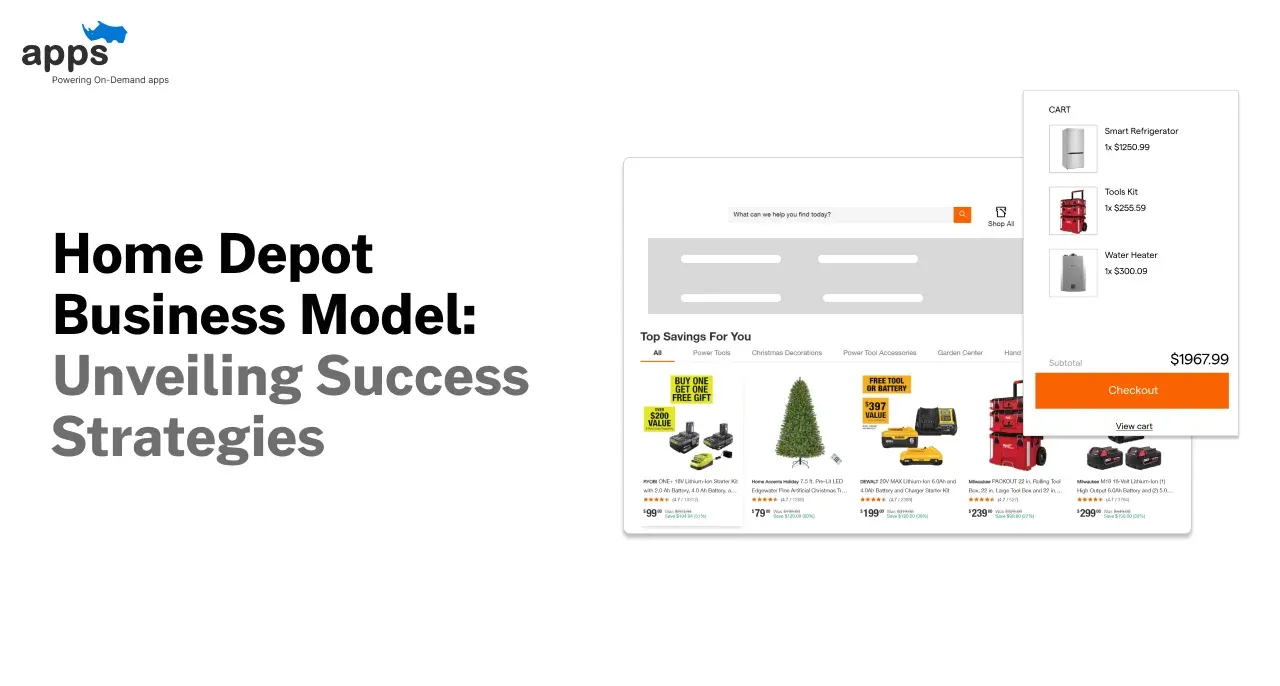
Most retailers chase trends. Home Depot built them.
When it launched in 1978, the founders didn’t just sell home improvement tools; they reimagined how America builds and renovates.
What started as a warehouse for DIY homeowners has become the most significant player in the U.S. home improvement industry, shaping how over 90 million households shop for renovation materials.
The secret? A Home Depot Business Model focused on affordability, innovation, and customer experience. Backed by smart supply chain optimization, a strong omnichannel retail strategy, and data-driven decision-making, Home Depot continues to dominate a market worth over $900 billion.
This blog unpacks why Home Depot was created, how its model works, and the strategies behind its long-standing success.
What is Home Depot Business Model & Its Advantages?
The Home Depot Business Model revolves around one core idea: making home improvement accessible, affordable, and efficient for everyone.
Founded to serve DIY homeowners and professionals alike, The Home Depot, Inc., built its empire by offering convenience, variety, and expertise under one roof.
Over the years, it has expanded through strong branding, digital innovation, and an omnichannel retail strategy, keeping it at the top of the U.S. home improvement industry.
The Home Depot business model has several key advantages that have contributed to the company's success.
1. Wide Product Assortment
Home Depot offers over 35,000 in-store products and 1 million online products across categories such as tools, decor, appliances, and building materials. From weekend DIYers to professional contractors, its catalog ensures everyone finds what they need.
The Pro Xtra Program further enhances this advantage by offering bulk discounts, delivery options, and business tools for professionals.
2. Strong Brand Reputation
The company Home Depot has built unmatched credibility through decades of reliable service, quality products, and community engagement. The mission statement for home depot is, “to help customers build their dream homes,” drives trust and long-term loyalty across diverse customer segments.
3. Competitive Pricing Strategy
With its home renovation revenue model pricing strategy, Home Depot combines affordability with quality. Its Everyday Low Price (EDLP) approach, coupled with seasonal offers and bulk discounts, attracts price-conscious buyers without compromising profit margins, reflecting a well-balanced Home Depot budget-friendly strategy.
4. Customer Engagement & Loyalty
The Home Depot marketing strategy focuses on connecting with customers through personalized offers, digital channels, and loyalty programs like Pro Xtra.
This initiative rewards consistent buyers with perks, while its online experience ensures a smooth user experience across mobile and web platforms.
5. Sustainability & Responsibility
Home Depot’s sustainability initiatives focus on reducing carbon emissions, sourcing responsibly, and promoting energy-efficient products. Its efforts in corporate social responsibility not only strengthen its brand reputation but also appeal to modern eco-conscious consumers, proving that profit and purpose can coexist.
In essence, the Home Depot Business Model succeeds by blending affordability, innovation, and responsibility, making it a true leader in the DIY retail industry.
Business Model Canvas of Home Depot
To understand why Home Depot dominates the U.S. home improvement industry, we need to look at its Home Depot Business Model Canvas.
This framework shows how every part of the company, from pricing and logistics to marketing and partnerships, works together to create value.
1. Value Proposition
Home Depot’s mission is to deliver value through affordability, quality, and convenience. The company offers a budget-friendly strategy without compromising on product range or service quality.
Key elements include:
- A one-stop destination for DIY homeowners and professional contractors.
- Competitive pricing through its home renovation revenue model pricing strategy.
- Services like installation, rentals, and same-day delivery.
- Expert staff support and online DIY guides.
This blend of price, variety, and service builds lasting trust with millions of customers.
2. Customer Segments
The Home Depot serves multiple audiences across the home renovation and improvement market:
- DIY homeowners looking for affordable tools and materials.
- Professional contractors and builders need bulk materials and specialized tools.
- Commercial clients include property managers, maintenance firms, and construction companies.
Its Pro Xtra Program caters to contractors with exclusive discounts, credit options, and reward benefits, reinforcing customer loyalty
3. Channels
Home Depot uses an omnichannel retail strategy that connects digital and physical experiences:
- Over 2,300 retail stores across North America.
- A seamless e-commerce website and mobile app for ordering and pickup.
- Integrated supply chain and curbside pickup for convenience.
- Social media, email, and app notifications for customer engagement.
These channels ensure accessibility and consistency across every shopping experience.
4. Customer Relationships
Home Depot builds strong relationships through personalization and reliability.
- Loyalty initiatives like the Pro Xtra Program and DIY workshops.
- 24/7 customer support through chatbots and trained experts.
- Community-driven marketing that supports local housing and sustainability programs.
- DIY content and project tools on digital platforms that empower customers to learn and build.
5. Key Activities
Core business activities that drive Home Depot’s operations include:
- Supply chain optimization and inventory management.
- AI-driven retail technology for demand forecasting and product placement.
- Developing private-label brands to increase margins.
- Providing in-store workshops and professional services.
- Managing logistics, fulfillment, and vendor partnerships.
6. Key Partners
Home Depot collaborates with:
- Suppliers and manufacturers for sourcing quality materials.
- Logistics partners to maintain timely deliveries.
- Technology partners to enhance data systems and e-commerce.
- Sustainability and community organizations to support corporate social responsibility (CSR) initiatives.
These alliances strengthen efficiency and improve the customer experience.
7. Cost Structure & Revenue Streams
Cost Structure: Home Depot’s main costs include operations, warehousing, marketing, and employee training. It invests heavily in AI-driven systems, automation, and store modernization to stay competitive.
Revenue Streams:
- Product sales from stores and online platforms.
- Installation and tool rental services.
- Pro Xtra memberships and vendor partnerships.
- Seasonal promotions and bulk purchase programs.
This diversified revenue model ensures stability even during market fluctuations.
The Home Depot Business Model Canvas illustrates how every process, from procurement to customer engagement, aligns with its mission of “helping people do more for less.”
Next, we’ll explore how this model translates into real profits and growth strategies.
How Does Home Depot Make Money
Home Depot blends high-traffic stores, fast digital fulfillment, Pro contractor spend, and add-on services to keep revenue broad and resilient.
The model is data-driven: more orders flow through stores, Pro mix keeps rising, and recent acquisitions expand a trillion-dollar opportunity set.
Retail Store Sales In-store revenue model
- Core engine: FY 2024 net sales were $159.5 B (+4.5% YoY), anchored by 2,347 stores; Q4 FY 2024 sales were $39.7 B (+14.1% YoY; 14th week added ~$2.5 B).
- Store productivity: Q4 FY 2024 comps +0.8% overall, +1.3% U.S. (flat to modest growth while traffic mixes).
E-commerce & Omnichannel Sales online, pickup, delivery
- Digital growth: Online sales grew ~4% YoY in Q3 FY 2024; ~50% of online orders were fulfilled from stores (BOPIS/curbside) according to reports shared by Digital Commerce 360.
- Momentum into 2025: In Q2 FY 2025, online sales grew >2× the rate of total sales; total sales up 4.9% YoY to $45.28 B; comps +1.0% global, +1.4% U.S.
Pro Services & Installations contractor-focused model
- Mix shift: Reuters reports that Management and industry coverage indicate the Pro segment is approaching ~50% of sales, reinforced by targeted investment in Pro ecosystems and distribution.
- Capacity expansion: The $18.25B SRS Distribution deal (closed Jun 2024) broadened the reach of the roofing/landscape/pool trade; management cites TAM expansion toward ~$ 1 T.
- Network build-out: New Pro-focused distribution sites launched in Detroit, SoCal, San Antonio, and Toronto to speed deliveries for contractors.
Tool Rental & Extended Warranties
- Scale signal: Home Depot operates ~1,300 rental locations, with “Rent Online, Pick Up In-Store” to offer convenience and repeat usage.
- Attachment economics: Extended protection plans (with Allstate) add fee revenue and reduce friction on big-ticket categories (appliances, OPE, electronics).
Home Renovation Revenue Model Pricing Strategy: How it balances margins
- Margin profile: FY 2024 guidance/print points to ~33.4% gross margin and ~13% operating margin, reflecting mix, promo cadence, and supply-chain efficiency.
- Levers:
- Store-fulfilled digital orders lower last-mile costs for many baskets (nearly 50% store-fulfilled).
- Pro mix expansion (SRS + Pro DCs) pushes larger tickets and repeat frequency.
- Scale in purchasing and logistics disciplines stabilizes costs through the cycle.
Home Depot’s revenue model stacks dependable store traffic, faster digital, and a rising Pro share, then adds services to deepen lifetime value.
Next up, we’ll look at supply chain, pricing, and operational efficiency that keep this engine running.
Embracing Innovation: Technology and Customer Experience
Technology lies at the core of the Home Depot Business Model. Over the years, The Home Depot, Inc. has redefined the U.S. home improvement industry by combining innovation, data intelligence, and a customer-first mindset.
Its approach ensures that technology not only boosts efficiency but also creates seamless, personalized experiences for every shopper.
How Home Depot Innovates with Technology
- AI-Powered Assistance: Home Depot’s new Magic Apron AI tool helps customers plan home projects, get personalized product advice, and visualize materials in real time. Associates also use Sidekick, an AI app developed with Google Cloud, to restock and locate inventory faster.
- Smart Data & Cloud Infrastructure: The company uses advanced analytics through Google Cloud to forecast demand, optimize inventory, and reduce stockouts, supporting both its omnichannel retail strategy and supply chain optimization.
- Emerging Technology Investment: Tech Bullion reports show that Home Depot continues to test robotics, IoT sensors, and autonomous checkout systems to improve in-store efficiency and create a frictionless shopping experience.
- Mobile App Enhancements: Understanding the essential features of Home Depot's e-commerce app, which lets customers check availability, view products in 3D with AR, and schedule pickups or installations, all in one platform.
- Seamless Omnichannel Experience: Whether customers shop online, on mobile, or in-store, Home Depot ensures a consistent, connected experience. Home Depot budget-friendly strategy integrates pricing and promotions across all channels a crucial and crucial lesson for anyone looking to developing an e-commerce platform like Home Depot."
How Technology Elevates Customer Experience
- Personalized Recommendations: AI-driven systems analyze browsing and purchase data to offer tailored product suggestions and project ideas.
- Real-Time Support: Chatbots and digital advisors provide instant assistance, while in-store associates use mobile tools to locate items and process payments faster.
- Pro Xtra Integration: Professionals gain access to volume pricing, purchase tracking, and time-saving digital tools all designed to enhance long-term loyalty.
- Post-Purchase Convenience: From easy installation scheduling to real-time delivery tracking, Home Depot ensures a smooth customer journey even after checkout.
- Accessibility for All: The company is expanding accessible self-checkout systems with tactile and audio guidance to make retail technology inclusive for everyone.
By blending AI-driven retail technology, data analytics, and a human touch, Home Depot’s Business Model is future-proofing how people build, buy, and experience home improvement.
Supply Chain and Logistics: Efficiency and Effectiveness
The Home Depot, Inc. operates one of the most advanced logistics ecosystems in the U.S. home improvement industry, built on automation, analytics, and sustainability.
Its supply chain strategy drives fast fulfillment, cost control, and a customer experience aligned with the company’s mission statement of reliability and value.
1. Nationwide Distribution Network
Home Depot manages 150+ distribution and fulfillment centers across the U.S. and Canada, enabling next-day delivery for over 90% of American households.
These centers, spread strategically near major urban markets, reduce transit times and strengthen their omnichannel retail strategy by connecting e-commerce and in-store demand.
This structure supports continuous product flow while cutting operational overhead.
2. Technology-Driven Supply Chain Optimization
Home Depot integrates AI-driven retail technology, predictive analytics, and real-time monitoring to forecast demand and reduce stock imbalances. Machine learning tools analyze market data and seasonal trends to maintain optimal inventory levels across regions.
Automated routing systems improve transport efficiency and reduce delays, powering more innovative logistics within the home renovation and improvement market.
3. Sustainable and Responsible Logistics
Aligned with its environmental commitments, Home Depot’s logistics model focuses on cleaner and greener operations. The company aims to cut Scope 1 and 2 carbon emissions by 42% by 2030 through renewable energy, fuel-efficient fleets, and recyclable packaging.
Sustainability isn’t just a goal; it’s embedded in the Home Depot budget-friendly strategy that balances cost and conscience.
4. Supplier Collaboration and Vendor Integration
Home Depot partners with more than 10,000 suppliers globally, ensuring reliability and cost stability. Its Vendor-Managed Inventory (VMI) system enables suppliers to proactively track and restock items.
This transparency strengthens supply chain resilience, minimizes shortages, and supports Home Depot’s consistent customer-first approach within the DIY retail industry.
With automation, sustainable logistics, and collaborative partnerships, Home Depot’s supply chain optimization model defines what modern retail efficiency looks like.
Now, let’s quickly move towards the next section and understand the marketing and customer engagement strategies.
Marketing and Customer Engagement Strategies
The Home Depot, Inc. blends local marketing, digital storytelling, and loyalty programs to build strong community connections and make home improvement affordable, accessible, and inspiring.
Let’s take a look at how it's done.
Brand Promise – “More Saving. More Doing.”
- Home Depot’s brand message, “More Saving. More Doing.”, defines its identity. It speaks directly to both DIY homeowners and professional contractors, positioning the brand as a practical partner for every project.
- This tagline reflects the company’s home depot budget-friendly strategy, offering affordability without compromising quality while reinforcing its customer-first approach.
Advertising and Social Media Strategy
Home Depot’s marketing combines content-driven storytelling and digital engagement.
- On Facebook, Instagram, Pinterest, and YouTube, Home Depot shares DIY tutorials, seasonal promotions, and project inspiration through campaigns like DIY Workshops at Home.
- The brand collaborates with influencers and creators in the home renovation and improvement market, extending reach to younger audiences.
- User-generated content using hashtags like #DIYwithHomeDepot boosts visibility and brand authenticity.
Recent campaigns, such as How Doers Get More Done, emphasize empowerment, inclusion, and community-driven values that align with its Home Depot marketing strategy.
Localized and Omnichannel Marketing
- Home Depot tailors marketing to local markets by adapting its products and promotions to regional climates and consumer preferences.
- Its omnichannel retail strategy integrates the website, mobile app, and in-store displays, ensuring customers receive a unified experience across channels.
- This localized approach strengthens brand relevance, especially in diverse urban and suburban markets.
Loyalty Programs and Community Engagement
- The Pro Xtra Program and My Home Depot Rewards represent the brand’s long-term loyalty strategy.
- These programs offer exclusive discounts, purchase tracking, and volume-based rewards for both professionals and everyday customers.
- Home Depot also sponsors local community programs, veteran housing initiatives, and disaster relief efforts, embedding social responsibility into its brand image.
In-Store Events and Educational Workshops
- Hands-on engagement remains central to the company, Home Depot’s customer experience.
- Events such as DIY Workshops and Kids’ Projects Saturdays build relationships while teaching practical skills.
- These experiences turn Home Depot stores into learning spaces, increasing foot traffic and reinforcing the brand’s leadership in the DIY retail industry.
Home Depot’s marketing blends storytelling, personalization, and purpose, creating not just a store, but a trusted community hub for home improvement.
Its customer engagement strategies show how consistency, local insight, and innovation build a brand that grows through trust.
Competitive Landscape & SWOT Analysis
To understand The Home Depot Business Model, it’s essential to see how it competes with other major players in the U.S. home improvement industry.
The table below compares Home Depot, Lowe’s, Menards, and Ace Hardware based on official, verified data.
Home Depot vs Lowe’s, Menards, and Ace Hardware
Feature / Brand | Home Depot | Lowe’s | Menards | Ace Hardware |
| Founded | 1978 | 1946 | 1960 | 1924 |
| FY 2024 Net Sales | $159.5 B | $83.1 B | ≈$13 B | $9.1 B (Co-op revenue) |
| Store Count / Presence | 2,300+ in the U.S., Canada & Mexico | 1,700+ in the U.S. | 300+ in the Midwest | 5,800+ globally (franchise model) |
| Membership / Loyalty Program | Pro Xtra & DIY Rewards | MVPs Pro Rewards | BIG Card & Rebates | Ace Rewards |
| Products & Model | Full home improvement & construction omnichannel retail strategy | Home improvement & garden online + stores | Regional DIY retail industry player | Franchise-based local hardware & home store model |
| Core Focus | Professionals, contractors, and DIY customers | DIY homeowners & small pros | Budget-conscious homeowners | Neighborhood convenience & service |
Home Depot SWOT Analysis
Understanding the Home Depot Business Model requires a close look at its internal strengths and external market challenges.
A detailed Home Depot SWOT analysis reveals how the company maintains leadership in the U.S. home improvement industry while adapting to evolving market trends and digital transformation.
Strengths
- Market Leadership: Home Depot is the most significant player in the U.S. home improvement industry, outpacing rivals in scale and showcased how to boost ROI using platform Home Depot.
- Efficient Supply Chain Optimization: Advanced logistics and vendor partnerships ensure strong product availability and cost control.
- Omnichannel Retail Strategy: Seamless integration of stores, online, and delivery enhances customer experience.
Weaknesses
- Limited Global Presence: Most operations are concentrated in North America, restricting global growth.
- High Operational Costs: Large store footprint increases expenses compared to online-only models.
- Dependence on U.S. Market Trends: Sales rely heavily on the domestic housing and renovation market.
Opportunities
- Digital Expansion: Growth in e-commerce and mobile shopping apps strengthens its Home Depot marketing strategy.
- Sustainability Focus: Energy-efficient products and eco-friendly sourcing appeal to modern consumers.
- Pro Market Growth: Rising demand from professionals through the Pro Xtra Program boosts the home renovation revenue model pricing strategy.
Threats
- Market Saturation: Intense competition from Lowe’s, Menards, and Ace Hardware in the DIY retail industry.
- Economic Slowdowns: Inflation and mortgage rates could impact home renovation spending.
- Supply Chain Disruptions: Global logistics issues can affect inventory and delivery speed.
This Home Depot SWOT analysis highlights a brand that continues to innovate, expand its digital presence, and strengthen sustainability initiatives, proving why the Home Depot Business Model remains a blueprint for success in the DIY retail industry.
Future Outlook: Sustainability and Expansion Plans for the Home Depot Business Model
The company emphasises its roots, why Home Depot was created, while building toward a future where professionals, homeowners, and communities thrive together.
This push is backed by strategic moves in home renovation revenue model pricing strategy, budget-friendly strategy, and digital innovation.
Sustainability
The company is making serious commitments to the planet as part of its long-term strategy.
- It plans to operate with 100% renewable electricity equivalent at all its facilities by 2030.
- It has set targets to reduce Scope 1 and 2 emissions by ~42% by 2030 from a 2020 base and “use of sold products” (Scope 3) emissions by 25 % by 2030.
- Through its Eco Actions programme, it supports sustainable product sourcing, packaging reforms, and supplier standards.
- This demonstrates how the company’s “about Home Depot” story goes beyond retail: mission statement for home depot is weaved in that it values customers, communities, and the planet.
Expansion Plans
Growth is shifting toward professionals, services and advanced technology, aligning with the home renovation and improvement market.
- The company is heavily investing in its Pro Xtra Program aimed at professional contractors and businesses, recognising that these “Pro customers” are critical for future growth.
- It is broadening its home renovation services, job-site delivery, urban formats, and specialised product lines, supporting a home renovation revenue model beyond just retail.
- Smart store and warehouse automation, AI-driven retail technology, and supply chain optimisation remain key. This ties into its budget-friendly and Home Depot pricing strategies by driving efficiency and improving service.
Diversity, Equity & Inclusion
As part of its culture and brand, the company drives DEI across its workforce, supply chain,, and communities.
- The company has structured initiatives at every level to foster an inclusive work environment and equitable opportunities.
- This supports the company’s competitive advantage in the DIY retail industry and strengthens the impact of its corporate social responsibility initiatives on its brand reputation.
Key Focus Areas
- Focus on Pro customers: The Pro segment is quickly becoming a central pillar of Home Depot's business model.
- AI-driven personalisation: Digital tools and smart logistics are enabling a more personalised, responsive experience in the omnichannel retail strategy.
- Sustainability: Embedding eco-goals helps align the company’s operations with stakeholder value and strengthens its budget-friendly strategy.
- Expansion in home renovation services: Moving into services (not just selling products) boosts the home renovation and improvement market role.
- Smart store and warehouse automation: Supply chain optimisation and store technology underpin efficient fulfilment and reinforce Home Depot's dominance in the industry it's in.
This evolution shows how the company remains relevant and competitive in a changing market with rivals such as Lowe’s Companies, Inc. and Menards.
Next up, we’ll dive into its pricing and budget-friendly strategies, exploring how the company balances affordability with premium service.
Conclusion
In a world where retail giants rise through innovation and precision, the Home Depot Business Model stands as a masterclass in efficiency, technology, and customer trust.
By blending AI-driven retail technology, data insights, and a powerful omnichannel retail strategy, Home Depot has redefined how modern businesses operate and grow.
At AppsRhino, we enable companies to achieve that same level of impact.
Our enterprise-grade solutions, from custom warehouse management systems and retail automation to AI-powered analytics and customer experience platforms, help streamline operations, enhance scalability, and drive real growth.
Whether you’re expanding or transforming, we build the technology backbone that fuels your success.
Frequently Asked Questions (FAQs)
What is Home Depot's business model, and how has it contributed to the company's success?
The Home Depot Business Model focuses on affordable pricing, excellent service, and digital convenience. Its mix of online and in-store shopping keeps it ahead in the market.
How does Home Depot’s sustainability initiative affect its growth?
Home Depot grows by being eco-friendly, using renewable energy, reducing waste, and offering green products that attract environmentally conscious customers and build brand trust.
What role does technology play in Home Depot’s customer experience?
Technology makes shopping easier. AI tools, real-time stock updates, and the Home Depot app help customers find, compare, and buy products faster and smarter.
How does Home Depot’s loyalty program work?
The Pro Xtra Program gives professionals discounts, rewards, and helpful tools, making their shopping experience smoother while encouraging long-term customer loyalty.
What can startups learn from Home Depot’s pricing and retail model?
Startups can learn to pair a home renovation revenue model with exceptional service and tech integration, focusing on customer trust, operational efficiency, and scalable digital growth.
How does Home Depot effectively engage customers to drive loyalty and enhance the shopping experience?
By using localized marketing, social media engagement, and workshops, Home Depot builds community trust and brand connection while fostering loyalty through personalized experiences.
Share blog
Related Quick Blogs



Table of Contents

- What is Home Depot Business Model & Its Advantages?
- Business Model Canvas of Home Depot
- How Does Home Depot Make Money
- Embracing Innovation: Technology and Customer Experience
- Supply Chain and Logistics: Efficiency and Effectiveness
- Marketing and Customer Engagement Strategies
- Competitive Landscape & SWOT Analysis
- Future Outlook: Sustainability and Expansion Plans for the Home Depot Business Model
- Conclusion
- Frequently Asked Questions (FAQs)